
 News
NewsThe Strategic Edge: Integrating the Trinkle DM-35 Magnetic Drill into Advanced Steel Fabrication Workflows
The Strategic Edge: Integrating the Trinkle DM-35 Magnetic Drill into Advanced Steel Fabrication Workflows

In the modern landscape of structural steel fabrication, the drive toward automation is undeniable. Massive CNC plate processors, high-speed beam lines, and robotic welding cells dominate the factory floor. However, seasoned production managers know that the efficiency of a facility is not just measured by its largest machines, but by how it handles the "exceptions"—the design changes, the assembly misalignments, and the intricate finishing touches that a 20-ton CNC machine simply cannot reach.
This is where the Trinkle DM-35 Magnetic Core Drill transitions from a simple hardware tool to a critical strategic asset. By understanding how to integrate the DM-35 with heavy machinery and automated workflows, fabricators can eliminate bottlenecks and ensure that production never grinds to a halt.
1. Precision Engineering: Beyond the Standard Drill
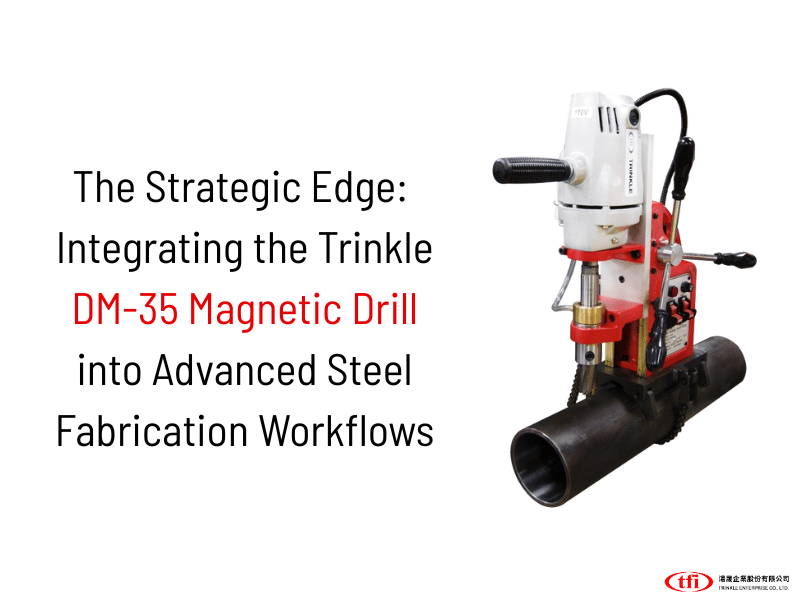
To understand its role in a production line, one must first look at the engineering that sets the DM-35 apart. Most portable magnetic drills utilize bronze bushings to secure the spindle. While cost-effective, bushings develop play over time, leading to "chatter" and premature cutter breakage. The DM-35 employs a high-rigidity spindle supported by a precision bearing seat. This ensures zero-wobble rotation, providing a level of hole accuracy usually reserved for stationary radial drills.
Furthermore, its advanced single-coil magnet technology allows it to maintain a secure grip on 3mm to 4mm thin plates, a feat many competitors cannot achieve without losing suction. This makes it an ideal bridge between heavy structural work and light industrial fabrication.
2. Technical Specifications: DM-35 at a Glance
The DM-35 is designed to balance lightweight portability with the high torque required for industrial-grade steel. Below are the core parameters that define its operational envelope.
| DM-35 PERFORMANCE SPECIFICATIONS | |
|---|---|
| Model | Trinkle DM-35 |
| Max. Drilling Diameter | Ø 35 mm (using Annular Cutters) |
| Max. Drilling Depth | 50 mm |
| Spindle Construction | High-Rigidity with Integrated Bearing Support |
| Magnet Technology | High-Efficiency Single-Coil Magnetic Base |
| Min. Plate Thickness | 3 mm ~ 4 mm (Suction Optimized) |
| Cooling System | Integrated Automatic Internal Lubrication Feed |
| Operational Versatility | Vertical, Horizontal, and Overhead Support |
3. Synergistic Integration: Where the DM-35 Meets the Production Line
The DM-35 is rarely a standalone solution; it is a "force multiplier" when paired with the following industrial equipment:
A. The "Offline" Partner to CNC Plate Processors
Large CNC drilling lines are designed for high-volume, repetitive hole patterns. However, once a plate is moved to the assembly area, "back-drilling" often becomes necessary due to last-minute engineering revisions or site-specific adjustments.
B. Collaborating with Beam Flippers and Rotators
In the fabrication of box girders or complex H-sections, access to the "web" or "flange" at odd angles is a constant challenge. Large machinery often has limited range of motion for secondary faces.
The Synergy: When used in conjunction with Hydraulic Beam Flippers, the DM-35 can be deployed the moment a beam is rotated. Since it can operate horizontally or even upside down, it allows for simultaneous processing: the main machine handles primary holes, while a technician uses the DM-35 to prepare attachment points for secondary brackets.
C. Post-Welding Precision
Welding induces heat deformation, which can shift the alignment of pre-drilled holes. In high-precision structural projects, fabricators often drill "critical fit" holes after the welding process is complete to ensure perfect alignment.
The Synergy: The DM-35’s ability to adhere to finished structural members makes it the ideal tool for this "post-weld" refinement, ensuring that the final assembly bolts together seamlessly on the construction site.
4. Economic Impact: Reducing Hidden Costs
The true value of integrating a DM-35 into a larger machine shop lies in the reduction of Non-Value-Added (NVA) time:
- Reduced Material Handling: Moving large steel members is the most dangerous and time-consuming part of fabrication. The DM-35 reduces crane usage by up to 20% by allowing for "in-place" processing.
- Minimized Rework: Because of the bearing-supported spindle, the DM-35 produces clean, burr-free holes, eliminating the need for secondary grinding or deburring.
- Labor Optimization: While the CNC line is running a long-duration program, a single operator can use the DM-35 to prep smaller components nearby, maximizing productivity.
Conclusion: The "Agile" Fabrication Philosophy
The Trinkle DM-35 is more than a portable drill; it is the "Agile Unit" of the steel factory. In an era where "Just-In-Time" delivery and complex architectural designs are the norms, the ability to be flexible is a competitive advantage. By pairing the DM-35 with large-scale CNC machinery and proper maintenance equipment, fabricators create a hybrid workflow that combines the raw power of automation with surgical portability.